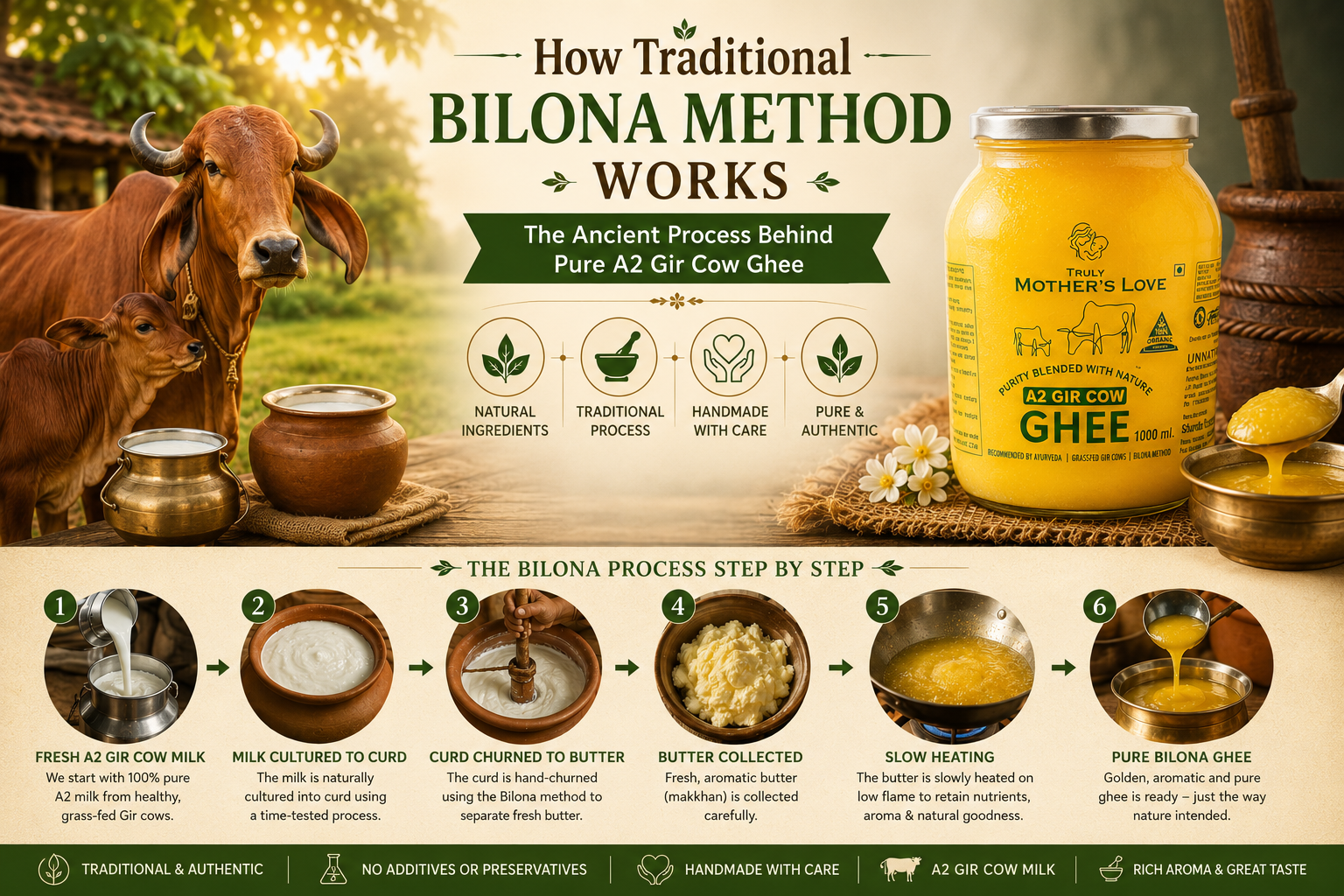
In a world where food production is becoming increasingly industrialized, traditional methods often hold the key to authenticity, nutrition, and quality. One such time-honored process is the Bilona Method, an ancient Indian technique used to prepare pure cow ghee.
At Unnati Organic, we believe that exceptional ghee starts with exceptional ingredients and a traditional preparation process. That’s why our A2 Gir Cow Ghee is crafted using the authentic Bilona method, preserving the natural goodness of milk just as it has been done for generations.
But what exactly is the Bilona method, and why is it considered superior to commercial ghee production?
Let’s take a closer look.
What Is the Bilona Method?
The Bilona method is a traditional Vedic process of making ghee that has been practiced in Indian households for centuries.
Unlike modern commercial methods that directly separate cream from milk and convert it into ghee, the Bilona process follows a much longer and more natural journey:
Milk → Curd → Butter → Ghee
This traditional transformation is what makes Bilona Ghee unique in taste, aroma, texture, and quality.
The Philosophy Behind Bilona Ghee
The word “Bilona” refers to the traditional wooden churner used to churn curd into butter.
Historically, families would hand-churn curd every morning to obtain fresh makkhan (butter), which would then be slowly heated to produce aromatic golden ghee.
The process emphasizes:
- Patience
- Traditional craftsmanship
- Small-batch preparation
- Natural fermentation
- Preservation of authenticity
At Unnati Organic, these principles continue to guide our ghee-making process.
How Unnati Organic Makes Traditional Bilona Ghee
Step 1: Sourcing Fresh A2 Milk from Indigenous Gir Cows
Everything begins with healthy Gir cows.
Gir cows are among India’s most respected indigenous breeds and naturally produce A2 milk.
At Unnati Organic:
✓ Cows are raised with care
✓ Fed naturally
✓ Maintained in a healthy environment
✓ Milked responsibly
The quality of the milk directly influences the quality of the final ghee.
Step 2: Fresh Milk Is Carefully Boiled
Once collected, the fresh A2 milk is gently boiled.
This step helps:
- Ensure freshness
- Preserve quality
- Prepare the milk for natural culturing
Unlike industrial production methods, the focus remains on maintaining the integrity of the milk.
Step 3: Milk Is Naturally Cultured into Curd
This is where Bilona differs significantly from commercial ghee production.
Instead of extracting cream directly from milk, the boiled milk is allowed to cool and is cultured into curd using traditional methods.
The curd is left to ferment naturally.
This step is important because:
- It follows traditional dairy practices
- Creates authentic flavor
- Supports the natural transformation process
This fermentation stage is one of the defining characteristics of Bilona Ghee.
Step 4: Traditional Churning Using the Bilona Process
After the curd is properly set, it is churned to separate butter from buttermilk.
Traditionally, this was done using a wooden churner called a Bilona.
The churning process creates:
Makkhan (Butter)
Used for making ghee.
Buttermilk
A nutritious by-product enjoyed in many Indian households.
This stage requires patience and skill because the butter must be separated naturally rather than through industrial shortcuts.
Step 5: Butter Is Slowly Heated
Once fresh butter is obtained, it is transferred into a vessel and heated slowly over a controlled flame.
This slow-cooking process allows:
- Moisture to evaporate naturally
- Milk solids to separate gradually
- Rich aroma to develop
- Natural golden color to emerge
The kitchen begins to fill with the unmistakable fragrance of authentic ghee.
Step 6: The Golden Ghee Emerges
As the butter continues to cook slowly, it transforms into pure golden ghee.
The result is:
✓ Rich aroma
✓ Golden texture
✓ Traditional taste
✓ Natural purity
✓ Authentic Bilona Ghee
The ghee is then carefully filtered and prepared for packaging.
Why Bilona Method Is Different from Commercial Ghee Production
Traditional Bilona Method
- Uses whole milk
- Milk converted to curd
- Curd churned into butter
- Butter converted into ghee
- Small-batch preparation
- Traditional process
Commercial Cream Method
- Cream separated directly from milk
- Cream heated directly into ghee
- Faster production
- Large-scale manufacturing
- Higher yield
The Bilona process requires significantly more milk and time, but many consumers value it for its traditional authenticity.
Why Does Bilona Ghee Cost More?
Many people wonder why authentic Bilona Ghee is priced higher than ordinary ghee.
The reasons are simple:
More Milk Required
A large quantity of milk is needed to produce a small amount of Bilona Ghee.
Longer Production Cycle
The process involves:
- Milk collection
- Curd preparation
- Fermentation
- Churning
- Slow heating
Labor Intensive
Traditional methods require skilled handling at every stage.
Small-Batch Production
Quality is prioritized over mass production.
The Unnati Organic Difference
At Unnati Organic, our focus is not just producing ghee.
Our goal is to preserve a traditional Indian dairy heritage.
Every jar of our A2 Gir Cow Ghee reflects:
- Indigenous Gir cow milk
- Traditional Bilona preparation
- Natural fermentation
- Small-batch craftsmanship
- Commitment to purity
We believe that food should be as close to nature as possible.
How to Identify Authentic Bilona Ghee
When purchasing Bilona Ghee, look for:
Transparent Sourcing
Brands should clearly mention the source of milk.
A2 Gir Cow Milk
Authentic premium Bilona Ghee often uses indigenous cow milk.
Traditional Preparation Details
The production process should be openly explained.
Natural Aroma
Authentic Bilona Ghee develops a rich, distinctive fragrance.
No Artificial Additives
Pure ghee requires no artificial colors or preservatives.
Frequently Asked Questions
What is Bilona Ghee?
Bilona Ghee is traditionally prepared by converting milk into curd, churning curd into butter, and slowly heating the butter into ghee.
Why is Bilona Ghee considered premium?
It requires more milk, more time, and follows a traditional preparation process that prioritizes quality over quantity.
Is Bilona Ghee made from cream?
No. Traditional Bilona Ghee is made from curd-derived butter, not directly from cream.
Why does Unnati Organic use the Bilona method?
We believe traditional preparation helps preserve authenticity, flavor, and the rich heritage of Indian dairy practices.
Is Bilona Ghee suitable for daily use?
Yes, it can be enjoyed as part of a balanced diet and traditional lifestyle.
Conclusion
The Bilona method is more than just a production technique—it’s a tradition passed down through generations. By transforming fresh A2 milk into curd, churning it into butter, and slowly cooking it into golden ghee, this ancient process preserves the authenticity that modern shortcuts often overlook.
At Unnati Organic, we continue this tradition with care and dedication, ensuring that every jar of A2 Gir Cow Ghee reflects purity, craftsmanship, and India’s rich dairy heritage.
